Home Office Resilience Is a Systems Problem, Not a Productivity One
Most knowledge workers are misdiagnosing their own failure. You blame your habits, but your home office infrastructure is the real culprit.
For example, you might hit a wall at 2:00 PM. Then, you struggle to regain focus after a Zoom call freezes for ten seconds. Perhaps you feel a vague, low-level anxiety when the wind picks up and the lights flicker during a storm.
The standard response to this friction is psychological. Consequently, you download a new task manager. You try a different “focus playlist” or a Pomodoro timer. You blame your discipline, your sleep hygiene, or your caffeine intake.
However, you are applying a software patch to a hardware failure.
The reality is that your home was built for sleeping, cooking, and watching Netflix. It was not engineered for high-availability cognitive output. In fact, you are attempting to run enterprise-grade workloads on consumer-grade hardware. Until you accept that your home office infrastructure is hostile to deep work, no amount of discipline will save you.
The Lie of Consumer-Grade Home Office Infrastructure
We have accepted a premise that is fundamentally broken: that a laptop and a WiFi password constitute a “workspace.”
In my first year working remotely, I treated focus as a willpower variable. Therefore, I tracked my hours religiously. I blocked websites to force concentration. Yet, my output remained inconsistent. One afternoon, purely by accident, I looked at the system logs on my consumer router during a period of what I called “brain fog.”
The router wasn’t down. The internet wasn’t “off.” On the contrary, the packet loss was sitting at 4% due to thermal throttling inside the plastic casing of the router. This is a classic failure of residential home office infrastructure.
My internet was just degraded enough to create micro-frictions—seconds of lag in loading pages, robotic voices on calls, VPN disconnects. These are not annoyances; they are cognitive interrupts. Because your environment forces you to handle a physical glitch, you burn glucose that was allocated for problem-solving. You aren’t tired because you’re lazy. You’re tired because you are manually compensating for a fragile system.
The Physics of “Burnout”: Real World Measurements
We need to stop talking about “wellness” and start talking about physics. The variables destroying your work are invisible, measurable, and boring. Specifically, I have spent the last six months monitoring my setup with industrial-grade sensors. The resulting data proves that remote work fatigue causes are often environmental, not psychological.
1. Air Quality (The Invisible Asphyxiation)
If you work in a standard 120-square-foot bedroom with the door closed to keep the noise out, you are likely breathing air at toxicity levels by early afternoon.
- The Myth: “I’m just sleepy after lunch.”
- The Measurement: Using an Aranet4 NDIR monitor, I tracked CO2 levels in my closed office. By 11:00 AM, levels consistently breached 1,400 ppm. Subsequently, by 2:00 PM, they hit 2,200 ppm.
- The Reality: Atmospheric CO2 is around 420 ppm. Some studies indicate that cognitive function begins to decline measurably at 1,000 ppm. However, at 2,000 ppm, strategic thinking capabilities drop by as much as 50%. You aren’t burning out; you are suffering from mild hypoxia.
█ TECHNICAL SPEC: ATMOSPHERIC LOGS
| VARIABLE | VENTILATED (CONTROL) | CLOSED DOOR (FAIL) | SYSTEM FAILURE |
|---|---|---|---|
| 11:00 AM LEVEL | 550 ppm (Near outdoor baseline) |
1,400 ppm (Stale air) |
Minor cognitive drag. 15% reduction in decision making speed. |
| 02:00 PM LEVEL | 650 ppm (Steady state) |
2,200 ppm (Toxicity threshold) |
Strategic thinking capability drops ~50%. “Brain fog” sets in. |
| SUBJECTIVE STATE | Alert / Neutral (Focus available) |
Lethargic / Irritable (Focus impossible) |
User blames “discipline” or “lunch,” ignores hypoxia. |
| RECOVERY COST | N/A (Linear workflow) |
45 mins + Ventilation (System reset) |
Work must stop. Environment requires physical intervention. |
Source: Personal logs via Aranet4 sensor. Cognitive impact correlations based on Harvard T.H. Chan studies.
2. Thermal Load and Cognitive Throttling
Your brain is a heat engine. It generates roughly 20% of your body’s heat. To function, it must dissipate that heat. If the ambient temperature is too high, that dissipation slows down.
- Measurement: I correlated my code commit logs with ambient room temperature over July and August.
- Result: My output drops off a cliff when the room temperature exceeds 79°F (26°C). Furthermore, at 82°F (28°C), my error rate (bugs found later) increased by 30%.
- Mechanism: When it gets hot, your body diverts blood flow from the brain to the skin for thermoregulation. Consequently, if you are sweating, you physically cannot think deeply.
3. Power Stability
A laptop battery that lasts “around 4 hours” is not a safety net; it is a ticking clock. This is the weakest link in most home office infrastructure.
- The Data: My UPS (Uninterruptible Power Supply) logs show an average of three “micro-sags” (voltage drops) per week in my residential grid.
- The Consequence: Without a UPS, each of these events would be a router reboot, a dropped call, and 15 minutes of recovery time. But more importantly, there is the psychological load. The subtle, background anxiety of watching a battery icon drain occupies working memory. If you don’t have a backup generator or battery, you are constantly running a background process in your brain called “Don’t disconnect.”
Redundancy, Not Optimization
The difference between a hobbyist and a professional is redundancy.
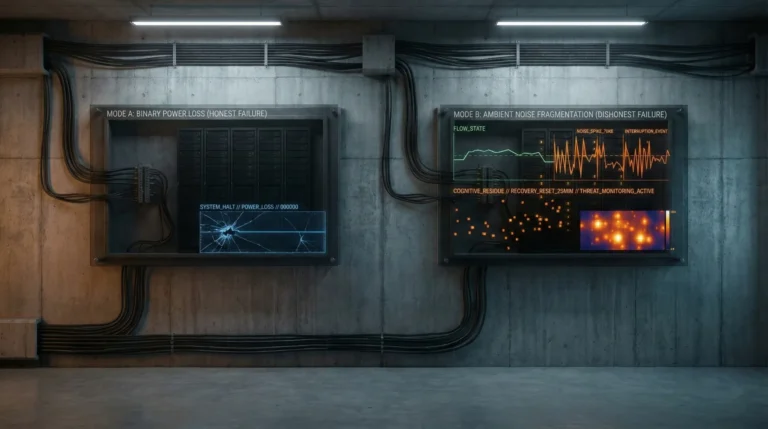
Data centers do not rely on “hope” or “flow states.” Instead, they rely on N+1 redundancy. If a power line fails, a generator kicks in. Alternatively, if a hard drive fails, a RAID array takes over. The system is designed with the assumption that failure is inevitable.
Therefore, your home office infrastructure should follow the same logic. You are the data center.
- Energy: Do you have a UPS that bridges the gap between a blackout and a safe shutdown? Additionally, do you have a portable power station for longer outages?
- Connectivity: Do you have a secondary line (4G/5G/Starlink) that automatically bonds with your primary connection so a fiber cut doesn’t end your workday?
- Environment: Do you have active ventilation (ERVs) to swap air without opening a window to street noise?
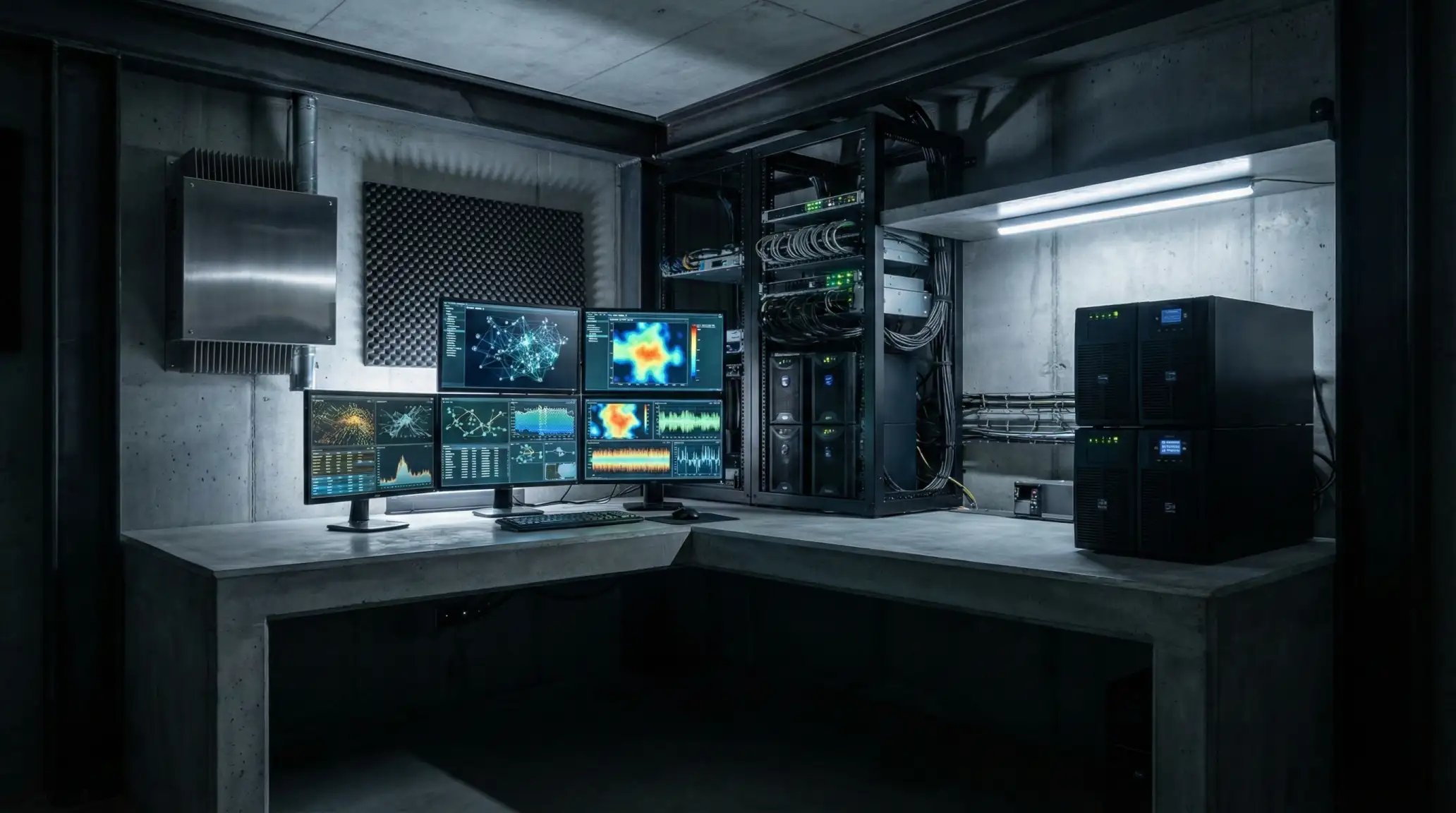
This is the Cognitive Bunker philosophy. We do not optimize for the best-case scenario (a quiet, sunny day with perfect internet). Rather, we engineer for the worst-case scenario (heatwave, construction noise, ISP failure).
The Verdict
Stop trying to “hack” your brain.
If your internet creates friction, buy a better router or a second line. If your room is stuffy, fix the ventilation mechanics. If your power is unstable, buy a battery backup.
You cannot meditate your way out of a high-latency connection. Nor can you “mindset” your way out of CO2 poisoning.
The goal is not to build a “cozy” workspace. The goal is to build a vessel that protects your attention from a chaotic world. Once the physical layer is secured, you might find that your “discipline problem” disappears on its own.