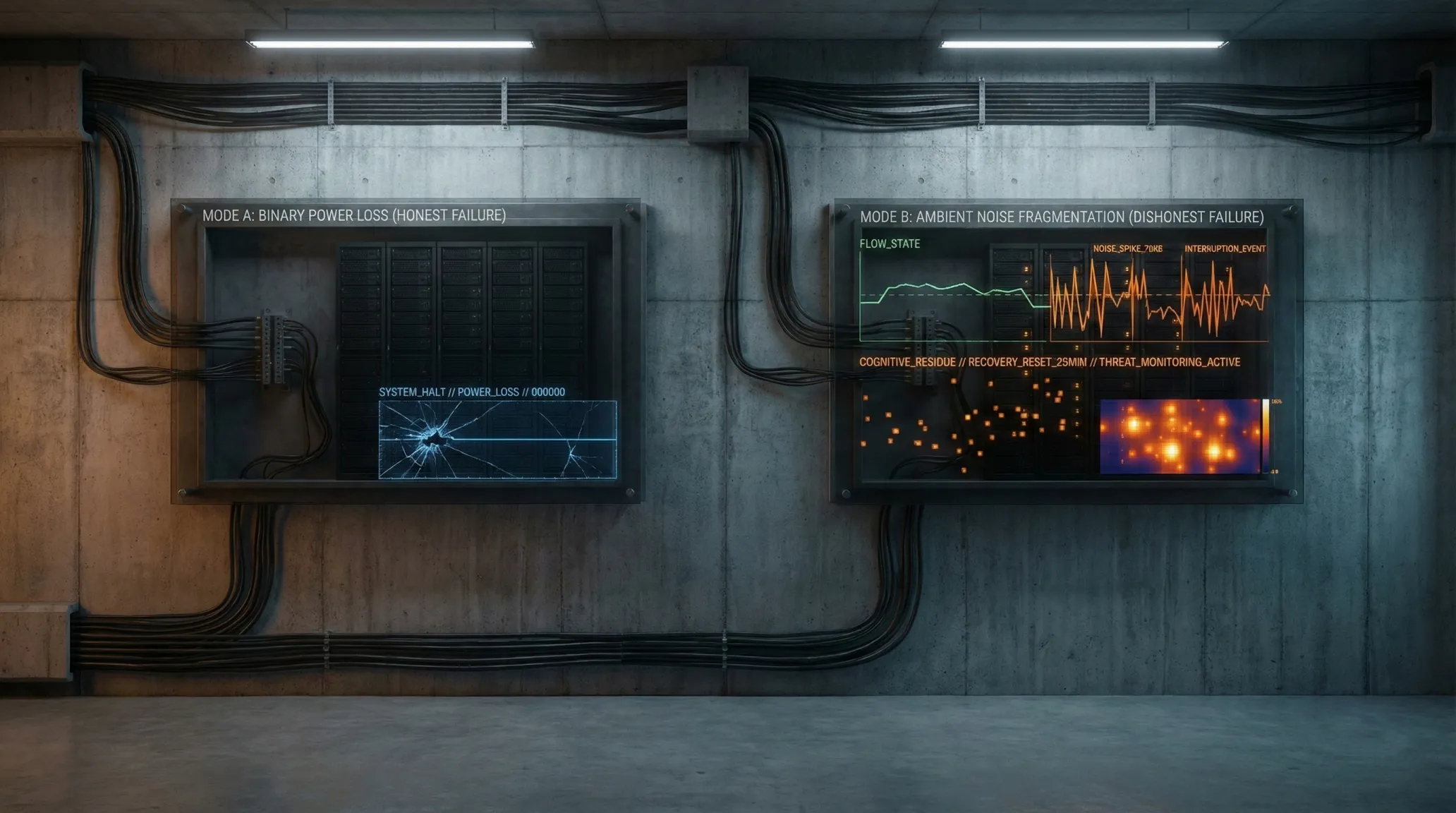
A power outage is an honest failure. When the grid goes down, the boundary is absolute. You cannot work, so you stop. Consequently, you switch to a notebook, or you walk away. The failure is visible, external, and binary.
However, noise is a dishonest failure.
It allows you to sit at your desk. Superficially, the environment permits you to move your mouse. Ultimately, it tricks you into believing that because you are present, you are working. This is a lie.
Most remote workers fear the blackout because it feels dramatic. But in my logs, the blackout is cheap. In fact, it is the days of intermittent noise that bankrupt the quarter.
The measured reality of “fragmentation”
We tend to quantify disruption by time lost. Yet, this is the wrong metric.
If the power dies for one hour, you lose one hour. The math is linear.
Conversely, if a dog barks for 30 seconds every ten minutes, you don’t lose three minutes. You lose the entire hour.
I tracked this specific variable during a week of construction next to my home office in Alicante (Spain). The ambient noise floor jumped from 38dB to spikes of 75dB.
█ TECHNICAL SPEC: THE LOGS
| VARIABLE | CONTROL DAY (A) | VARIABLE DAY (B) | SYSTEM FAILURE |
|---|---|---|---|
| NOISE FLOOR | 38 dB (Library quiet) |
38 dB baseline / 75 dB spikes (Drilling) |
Startle response. Adrenaline spike prevents “flow state” entry. |
| INTERRUPTIONS | 0 (Steady state) |
14 Audible Spikes (Irregular intervals) |
High Vigilance Mode. Brain monitors environment instead of code. |
| DEEP WORK | 6.0 Hours (Complex tasks) |
0.0 Hours (Attempted) |
Total cognitive collapse. Relegated to email and admin tasks. |
| RECOVERY COST | N/A (Linear workflow) |
~23 mins per spike (Context switch) |
Math impossibility. Spikes occur faster than recovery time allows. |
Source: Personal logs, Alicante Spain. dB measured via calibrated SPL meter.
Technically, the noise only lasted about 20 minutes in total. However, in practice, my output on Day B was zero.
I wasn’t just distracted. I was vigilant. Specifically, my brain shifted from “processing code” to “monitoring threat.” Every time I started to sink into a complex problem, the anticipation of the next spike pulled me out.
Therefore, I didn’t lose 20 minutes. I lost the capacity to think for an entire afternoon.
The invisible variable: Cognitive Residue
The reason we misdiagnose this is because we treat attention like a light switch. We assume we can toggle it on and off instantly.
But neurobiology disagrees.
There is a concept called “attention residue.” When you are forced out of a task—by a slack ping, a slamming door, or a sudden drop in bandwidth—your brain doesn’t detach cleanly. Consequently, part of your processing power remains stuck on the interruption.
Recovering full context takes roughly 23 minutes.
If you are interrupted every 15 minutes, you are mathematically incapable of deep work. Essentially, you are permanently in the recovery phase.
A power outage forces a hard reset; you stop, wait, and restart.
In contrast, noise forces a “soft crash.” You keep running, but with 80% of your RAM hijacked by the environment.
Thresholds of degradation
Not all noise is equal. The volume (dB) matters less than the predictability.
I can write effectively in a coffee shop with a constant hum of 70dB. The noise is a steady state, so the brain filters it out as static.
On the other hand, a silent room (30dB) that is punctuated by a random door slam (60dB) is unusable.
The degradation trigger isn’t loudness. It’s variance.
Your brain can ignore a server fan. However, it cannot ignore a conversation through a thin wall. Language forces your auditory cortex to parse meaning, whether you want to or not.
The systemic trap
The danger of noise interruptions vs total outages is that noise feels like a personal failure.
When the power goes out, you blame the utility company. You feel no guilt.
But when you stare at a screen for four hours in a noisy house and produce nothing, you blame yourself. Initially, you think you lack discipline. Then, you mistakenly believe the solution is a better “mindset.”
You are wrong.
You are trying to run high-load server applications (your brain) on infrastructure with dirty power (your environment). No amount of willpower filters out a 70dB spike.
The verdict
If you have to choose between a reliable internet connection in a noisy room, or spotty internet in a silent bunker, take the bunker.
You can cache a website. You cannot cache a thought.
Noise is not an annoyance. Rather, it is a structural breach in your cognitive hull. Until you treat soundproofing and isolation with the same seriousness as your internet contract, you are leaking value every single day.
No amount of discipline fixes this.